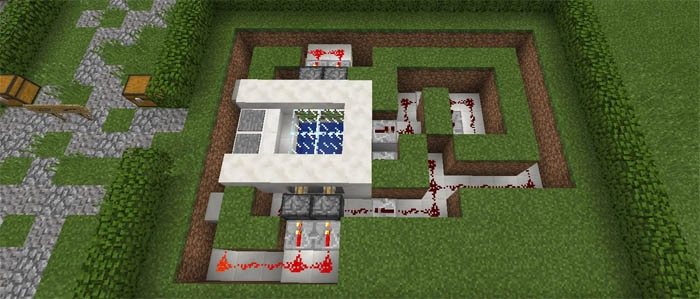
The pace of the game is dictated entirely by how the player wants to approach the game. If someone only cares about completing the main story, it is possible to rush through the game and complete it in approximately ten hours, but because of the volume of optional quests and activities it can extend well beyond one hundred hours. It is possible to build anywhere in the world, the player is not restricted to only having construction done in the base camp area. This will not effect the camp growth or progress the story but should the player desire it is possible to cover every square inch of land with construction. The scope of world is huge, and exploring to the end of it will give the player more things to build with nearly limitless potential. There are four different stages, all are unique from each other with different challenges and unique things to do.
VR Control mode has a number of options available for it, but the default is that turning is done by a series of instant changes, like teleporting in place but facing a different angle. Turn slowly and the jumps are tiny, turn fast and you get a much larger angle of change. Additionally, when you look while walking your “body” automatically changes direction to face the same way without the need to manually adjust it. The trick is to eliminate as much as possible anything that might cause dizziness, and although these changes wouldn’t work on a game like Doom they’re fine for something slower-paced like Minecraft. It may be weird and a little jarring but also surprisingly effective.
The big purpose of this episode is to find Ivor’s lair out in The Far Lands to find an enchantment book that has the power to destroy the command block that is still lingering inside of the Witherstorm. In a scene with both Soren and Ivor, Jessie discovers that the storm is following the amulet that Gabriel had given him and with that, Axel takes it upon himself to hold onto the amulet while Jessie retrieves the enchantment book. The group collectively agrees that Axel and another member of the Order of the Stone will return to Soren’s lair where the Enderman that Soren has collected can help in disassembling the Witherstorm as they had all witnessed them do in an earlier scene. While they are doing that, the plan is to then forge a weapon and fuse the enchantment book with it but in Jessie’s fight to do so, he is separated from Ivor who is helping everyone escape from a few lingering witches. Alone and lost, it is up to Jessie and his friends to pass through to Ivor’s lair, which happens to be riddled with booby traps and mazes, and return in time to defeat the storm.
Minecraft: Story Mode has managed to surprise fans of episodic games with every episode released. While the second episode might not have proven that, both Episode 1, Episode 3 and now Episode 4 have not disappointed. Probably the best episode yet in both content and character development, Minecraft: Story Mode – Episode 4: A Block and a Hard Place will leave you emotionally defeated. Lasting a little bit over two hours, the episode gives closure to the events that Jessie and his friends are facing in saving the world from the Witherstorm. It begins right where you left off last, either Ellegard or Magnus having died (according to the decision that you make) and Gabriel having been rescued but with no recollection of what has happened (a side effect from having Wither Sickness). You all run from the storm only to find safety in a cave, still within the storm’s range.
It’s safe to say that Minecraft has become one of biggest gaming phenomenons ever, earning mass cultural significance and merchandising opportunities, all while solidifying Persson’s creative mastery and contributing to the indie game boom of the 2010s, but Minecraft has taught many gamers and developers alike that there are ways to approach game design from other angles and still provide a fulfilling experience. When it comes right down to it, gaming hasn’t had the kind of creative milestone Minecraft has shown in a long time. It uses the gaming medium in groundbreaking ways that no other medium can use; it is a work of art in every sense of the matter.
Think about when you were a youngster and you went to the sandbox at the park. You weren’t told “build a sand castle” by your parents. You had your shovel, bucket and action figures and you did what you wanted. Fundamentally, you had no real goal; the end result was completely secondary to what you were doing to reach it. That’s the idea of a “sandbox” game: you aren’t being told what to do and you can feel free to express yourself creatively. You can break the status quo and go to places that you couldn’t otherwise. It’s not based around how much is given for you to do; it’s based around giving you tools and letting you discover what to do yourself.
